FinQA Final Presentation
Q&A system for financial reports and analyst reviews

Xianghui Xin
2023-37252

Julian Felix Kieslinger
2025-82736

Jiayue Wang
2022-21806
Team: 😈🔥
Date:
https://finqa-hallumaker-final.pages.dev
Presentation Outline
- Team Summary
- Overall Strategy & Architecture
- Results Evolution: From Baseline to Final
- Key System Enhancements
- Difficulties Encountered
- Demos
Team Summary
| Member | Role | Key Contributions |
|---|---|---|
| Xianghui Xin | Project Lead | Overall system architecture, Dynamic Question Categorization, Difficulty-based strategy implementation, Agent prompt optimization, Error analysis, Presentation materials. |
| Julian Kieslinger | Evaluation & Domain Insights | Model evaluation framework, Financial tool definition & testing, Question decomposition, Question keyword filtering, Github CI workflow. |
| Jiayue Wang | Data & Tooling | Retrieval improvement (retrieval scope extension, temporal alignment, question rewriting, and document reranking), Math & Fin tool extensions, Inference scaling, Result verifier component, Document embedding strategies. |
Collaboration Strategy
- Weekly team meetings to discuss progress
- Task assignment based on expertise
- Regular code reviews and pair programming
Overall Strategy & Architecture
flowchart LR
%% Main flow
User([User Query]) --> Client["MCP Client
(MultiServerMCPClient)"]

%% Client to Router communication
Client -->Router["Question Router
(Strategy Selector)"]

%% Router to Strategy selection
Router -->|"Applies strategy
based on level"| ReAct["ReAct Agent
(LangGraph)"]

%% Server section with detailed communication
subgraph Servers["MCP Servers (Tool Providers)"]
	direction LR
	ReAct -->|"Tool calls"| Math["Math Server"]
	Math -->|"Calc results"| ReAct

	ReAct -->|"Tool calls"| Finance["Finance Server"]
	Finance -->|"Financial metrics"| ReAct

	ReAct -->|"Search queries"| Chroma["Chroma Server"]
	Chroma -->|"Relevant chunks"| ReAct

	ReAct -->|"SQL queries"| SQLite["SQLite Server"]
	SQLite -->|"Structured data"| ReAct
end

%% Database connections
subgraph Databases["Data Sources"]
	direction LR
	Chroma -->|"Vector search"| ChromaDB[(Vector DB)]
	SQLite -->|"SQL queries"| CompanyDB[(Company DB)]
end

%% Verification and Final answer flow
ReAct -->|"Agent Execution Logs (Multiple Runs)"| Verifier["Result Verifier"]
Verifier -->|"Verified & Synthesized Answer"| Answer([Final Answer])

%% Styling
classDef userNode fill:#ffebee,stroke:#c62828,color:#c62828,rx:20,ry:20;
classDef clientNode fill:#e8eaf6,stroke:#3f51b5,color:#3f51b5,rx:10,ry:10;
classDef reactNode fill:#b2dfdb,stroke:#00796b,color:#00796b,rx:10,ry:10;
classDef serverNode fill:#f5f5f5,stroke:#424242,color:#424242,rx:5,ry:5;
classDef dbNode fill:#ede7f6,stroke:#4527a0,color:#4527a0,rx:0,ry:0;
classDef answerNode fill:#e8f5e9,stroke:#2e7d32,color:#2e7d32,rx:20,ry:20;
classDef verifierNode fill:#fff9c4,stroke:#f57f17,color:#f57f17,rx:10,ry:10;
classDef subgraphStyle fill:#fafafa,stroke:#9e9e9e,stroke-width:1px,rx:10,ry:10,color:#424242;

%% Apply styles
class User userNode;
class Client clientNode;
class Router clientNode;
class ReAct reactNode;
class Math,Finance,Chroma,SQLite serverNode;
class ChromaDB,CompanyDB dbNode;
class Verifier verifierNode;
class Answer answerNode;
class Servers,Databases subgraphStyle;
Core Orchestration (mcp_client.py)
The Engine Room: Powering FinQA
1. Multi-Server Initialization
	async with MultiServerMCPClient({
	"math": {
		"command": "python",
		"args": ["./servers/math_server.py"], ...
	},
	"fin": {
		"command": "python",
		"args": ["./servers/fin_server.py"], ...
	},
	"chroma": {
		"command": "python",
		"args": ["./servers/chroma_server.py"], ...
	},
	"sqlite": {
		"command": "python",
		"args": ["./servers/sqlite_server.py"], ...
	}
	}) as client:
	# ... main processing loop ...
2. Flexible Question Processing
	# Args: --first N, --last N, --all
	# if args.first:
	#   qa_dict = qa_dict[:args.first]

	for i, item in enumerate(qa_dict):
	question = item['Question']
	print(f"Processing Q{i+1}: {question}")

	level = await categorize_question_with_llm(
					question, categorization_model)
	# ... strategy selection ...
3. Multi-Run Strategy & Verification
	temp_list = []
	for _ in range(3): # Multi-run execution
	temp_result = await router.process_question(
		question,
		client=client,
		model=answering_model,
		recursion_limit=level_config['recursion_limit']
	)
	extracted_log = result_verifier.extract_info(
							question, temp_result)
	temp_list.append(extracted_log)

	# Verify and select the best answer
	results_list[i] = await result_verifier.verify_results(
									question, temp_list)
Impact: Robust orchestration for dynamic strategy application and reliable answer generation through multi-path reasoning.
Results Evolution: From Baseline to Final
Baseline Performance (Initial)
$ python score.py
	Overall Accuracy: 0.2600 (13/50)
	...
Our initial execution resulted an accuracy of 26%.
Initial Error Analysis
- Hallucination - LLM generating incorrect financial data
- Tool Selection - Choosing wrong tools for specific tasks
- Temporal Confusion - Mixing data from different fiscal years
- Complex Calculations - Errors in multi-step financial formulas
Midterm: Impact of Question Categorization
Improved Performance (Post-Categorization)
Overall Accuracy: 0.3400 (17/50)
Question Distribution:
Level 1: 16 questions - Accuracy: 0.6250 (10/16)
Level 2: 8 questions - Accuracy: 0.2500 (2/8)
Level 3: 2 questions - Accuracy: 1.0000 (2/2)
Level 4: 12 questions - Accuracy: 0.2500 (3/12)
Level 5: 12 questions - Accuracy: 0.0000 (0/12)
Level and Correctness Summary:
levels: 12111 11111 42421 42324 23112
        21111 55455 55444 55555 44454
answer: oxoox oooxo xooxx xooxo xooox
        xxoxx xxxxx xxxox xxxxx xxxxx
Number of Quesiton hitting recursion limit: 26Final: Advanced Prompting & Verification
Current Performance (Final Overview)
Overall Accuracy: 0.6200 (31/50)
Question Distribution:
Level 1: 16 questions - Accuracy: 0.7500 (12/16)
Level 2: 8 questions - Accuracy: 0.7500 (6/8)
Level 3: 2 questions - Accuracy: 1.0000 (2/2)
Level 4: 11 questions - Accuracy: 0.6364 (7/11)
Level 5: 13 questions - Accuracy: 0.3077 (4/13)
Final Results: Detailed Analysis
Level and Correctness Summary
levels: 12111 11111 42221 44324 23111
        21121 55555 55444 55555 44454
answer: oooox ooooo oooxx oxooo oooox
        xxooo ooxox xoooo xxxxx xoxxx
(o = correct, x = incorrect)
Error Analysis
=============================
ERROR ANALYSIS
=============================
	Multi Doc Failure     8 (16.0%)
	Wrong Calculation     6 (12.0%)
	System Error          2 ( 4.0%)
	Incomplete Data       2 ( 4.0%)
	Format Error          1 ( 2.0%)
Error Distribution
Key System Enhancements
Overall Categorization & Strategy Flow
flowchart LR
  A[Incoming Question] --> B[LLM Question Analyzer]
  B --> C{Difficulty Assessment}

  C -->|"Simple fact retrieval
(single data point lookup)"|L1[Level 1]
  C -->|"Simple calculations
on single document"|L2[Level 2]
  C -->|"Multi-step calculations
or temporal reasoning"|L3[Level 3]
  C -->|"Calculations involving
multiple documents/companies"|L4[Level 4]
  C -->|"Complex reasoning with
multiple factors/filtering"|L5[Level 5]

  L1 --> P1[Simple RAG Strategy]
  L2 --> P1
  L3 --> P2[Tool-First Strategy]
  L4 --> P2
  L5 --> P3[Agentic RAG Strategy]

P1 -->|"Direct retrieval +
concise numerical answer"|Result1[Answer]
P2 -->|"Extract metrics →
Temporal alignment →
Retrieve data → Calculate"|Result2[Answer]
P3 -->|"Entity identification →
Data gathering →
Calculation → Comparison"|Result3[Answer]

classDef level1 fill:#e0f7fa,stroke:#0288d1,color:#000;
classDef level2 fill:#e8f5e9,stroke:#2e7d32,color:#000;
classDef level3 fill:#fff3e0,stroke:#fb8c00,color:#000;
classDef level4 fill:#ede7f6,stroke:#5e35b1,color:#000;
classDef level5 fill:#ffebee,stroke:#d32f2f,color:#000;
classDef process fill:#f5f5f5,stroke:#333,stroke-dasharray:4 2,color:#000;
classDef llm fill:#f8bbd0,stroke:#880e4f,color:#000;
classDef defaultNode fill:#eee,stroke:#333,color:#000;

class L1 level1;
class L2 level2;
class L3 level3;
class L4 level4;
class L5 level5;
class P1,P2,P3 process;
class B,C llm;
class A,Result1,Result2,Result3 defaultNode;
flowchart LR
A[Incoming Question] --> B[LLM Question Analyzer]
B --> C{Difficulty Assessment}
C -->|"Simple fact retrieval
(single data point lookup)"|L1[Level 1]
C -->|"Simple calculations
on single document"|L2[Level 2]
C -->|"Multi-step calculations
or temporal reasoning"|L3[Level 3]
C -->|"Calculations involving
multiple documents/companies"|L4[Level 4]
C -->|"Complex reasoning with
multiple factors/filtering"|L5[Level 5]
L1 --> P1[Simple RAG Strategy]
L2 --> P1
L3 --> P2[Tool-First Strategy]
L4 --> P2
L5 --> P3[Agentic RAG Strategy]
P1 -->|"Direct retrieval +
concise numerical answer"|Result1[Answer]
P2 -->|"Extract metrics →
Temporal alignment →
Retrieve data → Calculate"|Result2[Answer]
P3 -->|"Entity identification →
Data gathering →
Calculation → Comparison"|Result3[Answer]
classDef level1 fill:#e0f7fa,stroke:#0288d1,color:#000;
classDef level2 fill:#e8f5e9,stroke:#2e7d32,color:#000;
classDef level3 fill:#fff3e0,stroke:#fb8c00,color:#000;
classDef level4 fill:#ede7f6,stroke:#5e35b1,color:#000;
classDef level5 fill:#ffebee,stroke:#d32f2f,color:#000;
classDef process fill:#f5f5f5,stroke:#333,stroke-dasharray:4 2,color:#000;
classDef llm fill:#f8bbd0,stroke:#880e4f,color:#000;
classDef defaultNode fill:#eee,stroke:#333,color:#000;
class L1 level1;
class L2 level2;
class L3 level3;
class L4 level4;
class L5 level5;
class P1,P2,P3 process;
class B,C llm;
class A,Result1,Result2,Result3 defaultNode;
1. Question Understanding & Strategic Routing
A. LLM-Powered Categorization
What: Uses gpt-4o-mini to classify questions into 5 difficulty levels based on a detailed prompt.
Prompt Snippet:
"You are an expert in financial analysis...
Categorize into: LEVEL_1 (fact retrieval), LEVEL_2
 (simple calc),... LEVEL_5 (complex reasoning)
Respond with ONLY a single number (1-5)"
Impact on Agent:
- Enables selection of the most resource-efficient and effective strategy.
- Avoids over-complication for simple queries and under-powered approaches for complex ones.
- Sets the stage for tailored agent behavior in subsequent steps.
B. Level-Specific Strategy Prompts (question_router.py)
Based on the category, a ReAct agent is invoked with a highly tailored prompt to guide its reasoning, tool use, and efficiency.
- Goal: Fast, direct retrieval.
- Prompt: "MAXIMUM 25 STEPS... Provide ONLY exact numerical answer..."
- Agent Behavior: Minimal steps, immediate answering.
- Goal: Structured calculation.
- Prompt: "OPTIMIZED ANALYTICAL PROCESS: EXTRACT, SEARCH, CALCULATE..."
- Agent Behavior: Methodical data extraction & tool use.
- Goal: Complex, multi-data reasoning.
- Prompt: "STREAMLINED APPROACH: IDENTIFY, SEARCH (ALL data upfront)... NO VERIFICATION"
- Agent Behavior: Broader data gathering before calculation.
2. Targeted Optimizations & Verification
A. Retrieval improvement
Query Rewriting:
- Retrieval scope extended (+ 5 years).
- Lookup Table-Based Fiscal Year-End Extraction.
- LLM-based normalization of relative time (e.g., "prior year" to "202X").
- LLM-based question rewriting into a formal financial language format.
- LLM-basedGeneration of multiple search queries related to the initial query.
- Impact: Reduced temporal confusion, more accurate data retrieval for time-sensitive queries.
Document reranking:
- Reciprocal rank fusion algorithm
$$\text{Score}(d) = \sum_{i=1}^{N} \frac{1}{k + \text{rank}_i(d)}$$
- A document may appear in multiple lists, and the final fused score is the sum of the reciprocal ranks from all the lists where it appears.
- $\text{rank}_i(d)$ is the rank of focument d in the ith ranked list;
- k is a constant (e.g., 60);
- N is the number of ranked lists.
B. Tool Extension
- calculate_eps
- calculate_operating_profit_margin
- calculate_current_ratio
- calculate_cashflowfromoperations
- calculate_shares_outstanding
- calculate_price_to_earnings_ratio
- calculate_market_capitalization
- calculate_ratio_of_metrics
- add
- multiply
- divide
- difference
- average
- sum_values
- convert_thousands_to_number
- convert_millions_to_number
- convert_billions_to_number
- calculate_percentage
- calculate_percentage_change
- average_list
C. Result Verification
- Large language monkeys: scaling inference compute with repeated sampling (3 times).
- A verifier LLM compares these answers and generate the final results.
Verifier Prompt Snippet:
"You are an expert verifier...
Compare multiple answers... Identify inconsistencies...
Select most coherent reasoning path ...
Or synthesize the best aspects of them into a final...
Final Verified Answer: ..."
Impact:
- Crucial quality control.
- Mitigates single-run errors.
- Boosts reliability by cross-checking reasoning paths.
Result Verifier Workflow
flowchart TD
subgraph Agent Run 1
	A1["Question"] --> P1["Agent Processing 1
(Tools, Reasoning)"] --> O1["Output Log 1
(Answer, Tool Calls, Responses)"]
end
subgraph Agent Run 2
	A2["Question"] --> P2["Agent Processing 2
(Tools, Reasoning)"] --> O2["Output Log 2
(Answer, Tool Calls, Responses)"]
end
subgraph Agent Run 3
	A3["Question"] --> P3["Agent Processing 3
(Tools, Reasoning)"] --> O3["Output Log 3
(Answer, Tool Calls, Responses)"]
end

O1 --> VerifierLLM["Verifier LLM
(gpt-4.1-mini)"]
O2 --> VerifierLLM
O3 --> VerifierLLM

VerifierLLM -->|"Comparison & Synthesis"| FinalAnswer["Final Verified Answer"]

classDef agentRun fill:#e3f2fd,stroke:#1e88e5,color:#000;
classDef verifier fill:#fff9c4,stroke:#f57f17,color:#000;
classDef io fill:#fce4ec,stroke:#ad1457,color:#000;
classDef answerNode fill:#e8f5e9,stroke:#2e7d32,color:#000;

class P1,P2,P3 agentRun;
class O1,O2,O3 io;
class VerifierLLM verifier;
class FinalAnswer answerNode;
3. Engineering for Iteration & Quality
A. Per-Question Correctness Tracking
score.py generates a concise visual summary showing the assigned difficulty level and correctness (o/x) for every question in the batch.
Level and Correctness Summary (Output from score.py):

levels: 12121 11111 42421 42324 24222
        22121 54445 55444 55555 44454
answer: oooox ooooo oooox oooxo oooox
        xxooo xxxoo xxoxo xxxxx oxxxx
(o = correct, x = incorrect)
Impact: Provides an at-a-glance overview of performance across different question types and individual questions, crucial for comparing experiment runs and quickly spotting error patterns or regressions.
B. LLM-Enhanced Error Classification
When simple pattern matching is insufficient, score.py leverages an LLM (gpt-4o-mini via error_classification_chain) for nuanced error analysis based on the question, correct answer, and LLM response.
# In score.py, within classify_error_with_ground_truth:

# ... (initial pattern-based checks) ...

# Fallback to LLM for complex cases:
llm_classification = error_classification_chain.invoke({
    'question': question_text,
    'correct_answer': actual_answer,
    'llm_response': model_output,
    'level': question_level
})
# Expected output from LLM (ErrorType Pydantic model):
# {
#   "error_category": "wrong_retrieval",
#   "error_subcategory": "selected_wrong_document_section",
#   "confidence": 0.85,
#   "reasoning": "The LLM retrieved data for a similar but incorrect metric."
# }
Impact: Provides deeper insights into failure modes beyond surface-level symptoms, guiding more targeted prompt and logic refinements. The structured JSON output aids in aggregating error statistics.
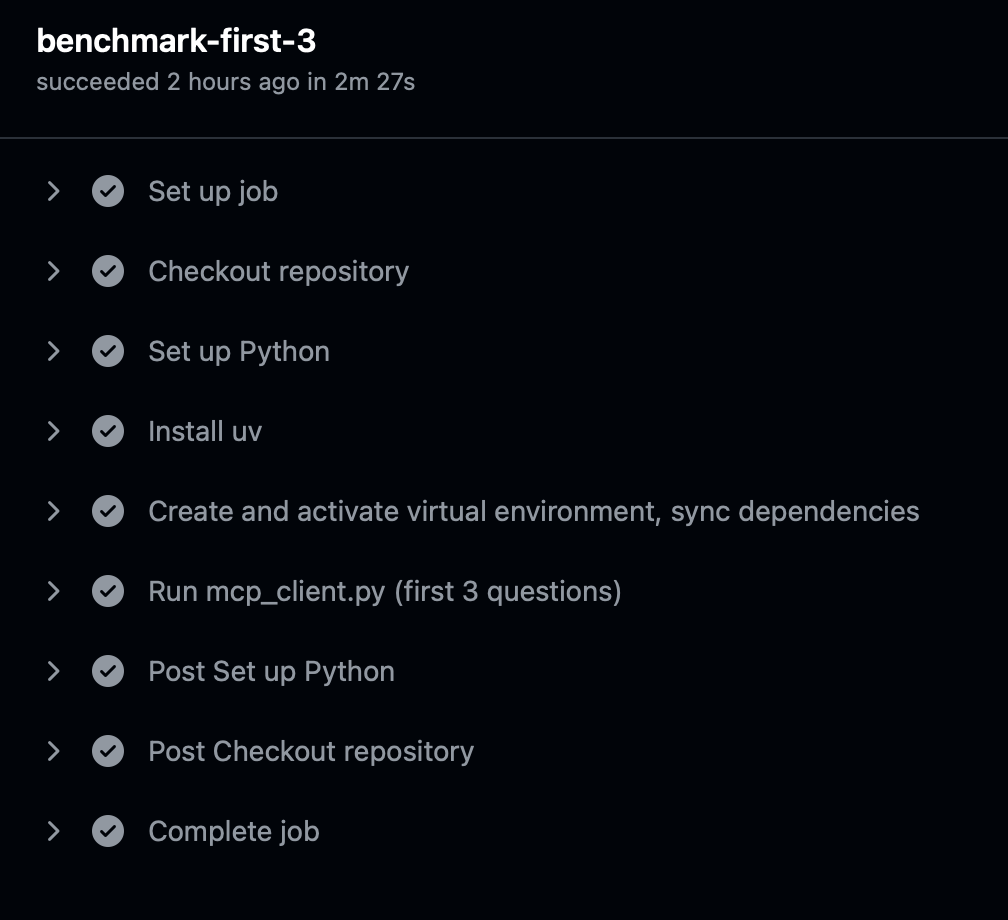
C. Automated & Flexible Evaluation with GitHub Actions
Command-line arguments in mcp_client.py (--first N, --last N, --all) enable targeted testing. These are leveraged by GitHub Actions for automated evaluation:
qa_dict_benchmark-first-3.yml: (Manual Trigger) Runs on the first 3 questions for a quick smoke test of major changes.qa_dict_benchmark-last-15.yml: (Manual Trigger) Tests the typically more complex last 15 questions.qa_dict_benchmark-all.yml: (On Push) Performs a full benchmark on all 50 questions to track overall performance and catch regressions.
Impact: Streamlined the testing pipeline, enabled quicker iteration, ensured consistent evaluation, and helped maintain code quality through automated checks.
Difficulties Encountered (What Didn't Work)
❌ Model & Embedding Experiments
- Temperature and Model Selection: Different models and non-zero temperatures led to inconsistent tool use and hallucinations.
- Embedding Parameters: Tuning chunk size, overlap, and table format did not significantly improve accuracy.
❌ Strategy & Architecture Attempts
- Keyword Augmentation: Adding financial keywords to queries often introduced noise.
- Pure RAG Approach: Failed on calculation-heavy questions requiring tools.
- Complex Prompt Chaining: Increased errors and execution time for no significant gain.
- Dynamic Routing Adjustments: Created inconsistent and unpredictable agent behavior.